Some stadium names feel timeless. Others feel temporary. The Patriots would not be the Patriots without Gillette Stadium. The Cowboys have AT&T Stadium. Atlanta has Mercedes-Benz Stadium. The Mets are Citi Field. Sponsorships in sports transcend advertising, finding a spot within a team's identity.
And yet, as with everything, change comes with time. After 20 years as Heinz Field, the Pittsburgh Steelers' stadium is now Acrisure Stadium. Staples Center became Crypto.com Arena. These rebrands remind us that even the most iconic partnerships eventually evolve, for better or worse.
While stadium naming rights have long been the most recognizable sponsorships, the landscape is evolving rapidly. Outside of the US, Premier League teams have long embraced sponsorships. Arsenal has featured an Emirates advertisement on its jerseys since 2006; Manchester City has boasted an Etihad sponsorship since 2011. Those deals are quickly becoming popular in American sports. NHL helmets now showcase a wide array of insurance groups, banks, car manufacturers, and even Oreo. Collegiate athletics feature on-field logos, like Walmart's partnership with Arkansas. MLB sleeves are occupied by branded patches. All but one NBA team features a jersey patch.
It's not going away, so getting sponsorships right is increasingly critical. Why does Citi Field feel right while Crypto.com Arena feels out of place? What makes some partnerships feel natural while others seem forced?
To explore that, I examined city-sponsor pairings across Major League Soccer, using demographic data and consumer spending patterns to identify both successful partnerships and untapped opportunities.
Mapping the MLS Market Landscape
The first step was mapping how different variables relate to one another. Both demographic factors and spending patterns in key categories are shown below for each MLS city in the US.
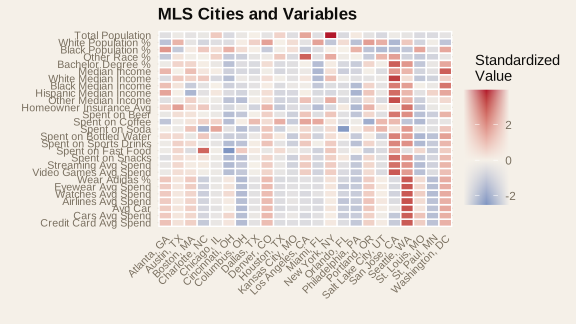
The heat map above tells two stories. 1) San Jose and Seattle are clear outliers — their demographic and spending patterns look nothing like the rest of the league. 2) Consumer spending naturally divides into two camps: luxury goods like airline travel, credit cards, and designer eyewear vs. normal goods like beer, sports drinks, and fast food. This split hints at why certain sponsors thrive in some markets but struggle in others.
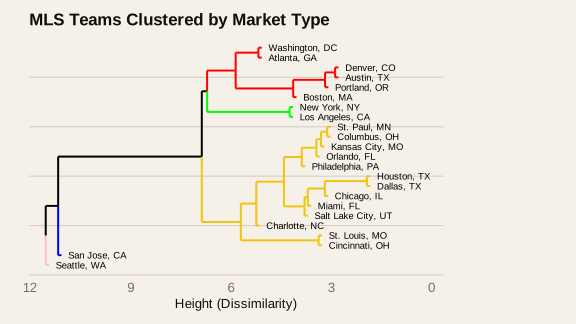
I applied hierarchical clustering to our dataset to explore how these cities naturally cluster together. The results confirm what the heat map suggested: San Jose and Seattle are extreme outliers, merging with other cities only at the far left of the dendrogram, indicating they share little in common with the rest of the league. At the opposite end, we see tightly grouped clusters. Houston and Dallas merge almost immediately, suggesting near-identical market profiles. A company currently sponsoring Houston Dynamo FC would likely find similar success with Dallas FC — and potentially in Chicago, which joins this Texas pair shortly after.
The dendrogram reveals several other natural groupings: Washington DC pairs closely with Atlanta; New York clusters with Los Angeles and Boston; and a large middle group of 13 cities cluster together, including markets like Philadelphia, Orlando, Kansas City, and Miami. For sponsors, this middle cluster represents fungible opportunities — choosing between Charlotte, Salt Lake City, or Cincinnati likely makes little difference from a market-fit perspective.
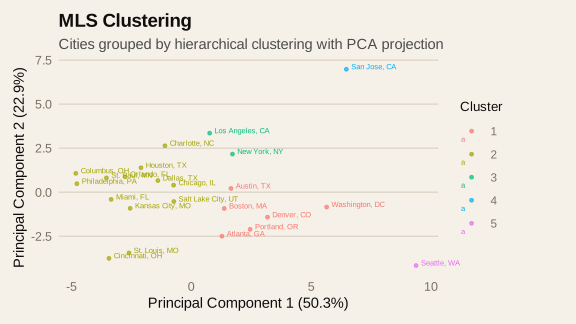
The plot reinforces what the dendrogram suggested: San Jose sits in extreme isolation at the bottom right, separated from every other MLS market by a considerable margin. Seattle occupies its own territory in the upper right quadrant. Between these two outliers and the main cluster lies substantial white space — a visual representation of just how different these West Coast tech hubs are from the rest of the league.
So what characteristics make each cluster unique?
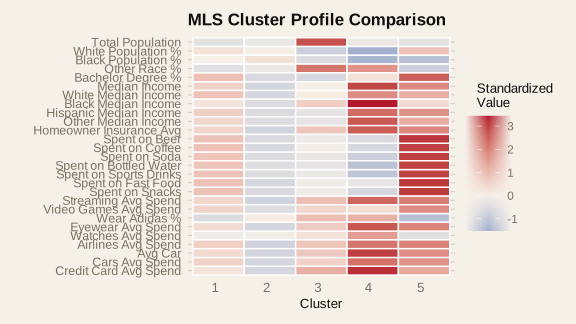
Cluster 1 (Atlanta, Austin, Boston, Denver, Portland, Washington DC) represents affluent, diverse metro areas with elevated spending across both luxury and everyday categories. This balanced profile might make them attractive to a wide range of sponsors, from premium brands to mass-market consumer goods.
Cluster 2 (Charlotte, Chicago, Cincinnati, Columbus, Dallas, Houston, Kansas City, Miami, Orlando, Philadelphia, Salt Lake City, St. Louis, St. Paul) forms the league's largest grouping — 13 mid-market cities that consistently spend slightly below average across most categories. For brands with limited budgets or those seeking predictable returns, this cluster offers efficient scalability without requiring market-specific customization.
Cluster 3 (New York, LA) comprises the two largest metros, showing moderately elevated spending on luxury goods alongside average everyday consumption. With two MLS teams apiece, these cities provide plenty of options for brands looking to form partnerships.
Cluster 4 (San Jose) stands alone as an extreme outlier — the wealthiest market by far, with dramatically elevated luxury spending but well below average spending on beer, coffee, soda, fast food, and sports drinks. This creates a sponsorship paradox: despite its wealth, San Jose is not a great fit for many of MLS's top sponsors. Brands like Heineken and Coca-Cola may have to stretch their marketing dollars more here for the same returns they would expect to see elsewhere.
Cluster 5 (Seattle) presents perhaps the most sponsor-friendly profile in the league. Seattle combines strong income levels and elevated luxury spending with robust everyday consumption. Unlike San Jose's wealth-without-mass-market-appeal, Seattle delivers both.
Finding Gaps
Clustering analysis can provide a foundation, but it doesn't help find gaps in the MLS sponsorship landscape. To identify these gaps, I built a machine learning model (using XGBoost frameworks) to estimate the likelihood of any given brand sponsoring any given team based on the team's market characteristics. For every possible team-sponsor pair, the model predicts the probability of sponsorship. High prediction errors reveal gaps, with two possible scenarios:
- Predicted sponsorship, but none exists: Untapped opportunities where market fit is strong but no partnership has been formed
- Active sponsorship, but low predicted probability: Existing deals that don't align well with the market's characteristics
Case Studies
Chicago Fire
Chicago's strongest untapped sponsorship opportunities come in the beverage and retail/apparel categories. The model identifies Pepsi and Coca-Cola, neither a current Fire sponsor, as encouraging potential partners. Further, popular rum brands Flor de Cana and Bacardi could be promising additions to Chicago's marketing mix.
The model flags a pair of beer sponsors as poor fits: Tecate and Heineken, the latter of whom also serves as the Fire's primary sponsor. This should be among their biggest concerns from a marketing perspective, as losing a sponsor of Heineken's caliber would dramatically hurt Chicago's revenue.
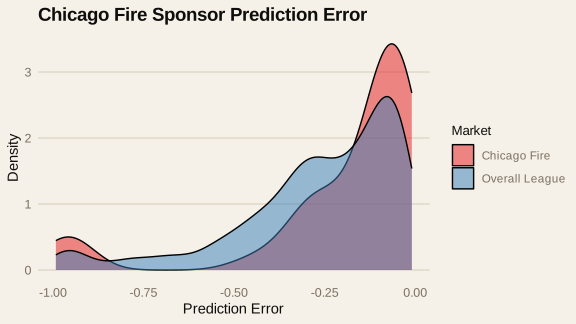

On the whole, Chicago's mix of sponsors stacks up very favorably against the rest of the league. Chicago should focus on gradually diversifying their sponsor portfolio to reduce dependence on Heineken while exploring how to improve their fit with the Dutch beer brand.
Charlotte FC
Charlotte's top sponsorship opportunities come mostly in the beverage category, both alcoholic and non-alcoholic. Three current non-sponsor alcohol brands would fit Charlotte's city well, with Flor de Cana, Heineken, and Dos Equis among the model's five strongest potential additions. Non-alcoholic options include SuperPretzel, Rock 'Em Apparel, and Starry.
Charlotte's weakest sponsorships include a pair of apparel brands in Retro Brand and Majestic — replacing one of these deals with a deal with Rock 'Em Apparel could be popular among Charlotte fans.
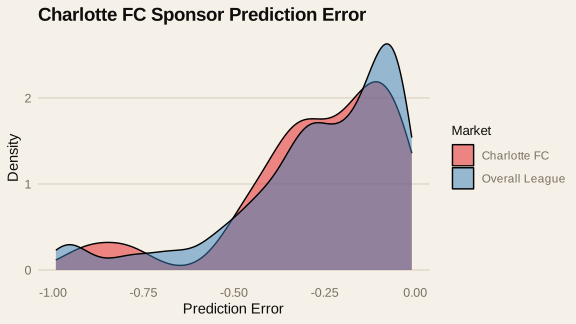
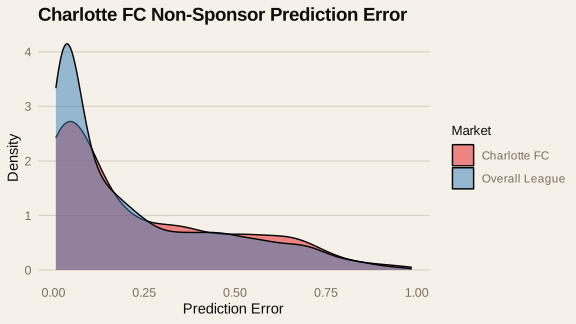
Overall, Charlotte's portfolio matches up similarly to the rest of the league for sponsors but worse for non-sponsors — indicative of a struggle to identify and sign brands that resonate with the market's specific characteristics, potentially leaving significant sponsorship revenue on the table.
Heineken
Heineken has one of the largest marketing portfolios of any brand in the MLS, sponsoring all but three teams. Among the three non-partner teams, Charlotte is the best choice for a new sponsorship. Heineken's choice not to sponsor DC United appears strategically sound, as the market characteristics don't align well with the brand. In terms of their existing portfolio, Chicago is the only existing partner the model recommends dropping. Replacing their sponsorship with the Chicago Fire with a sponsorship with Charlotte FC might make a lot of sense.
EA Sports
EA Sports is, like Heineken, a prolific sponsor of the MLS, with all but four American teams counted in EA's sponsorship pool. Unlike Heineken, there are no real outliers among its partner teams — each of their sponsor teams appears to fit the brand. The model identifies Cincinnati and Houston as strong potential additions among non-partner teams. Overall, EA appears to have a strong, well-balanced portfolio.
Why Fit Beats Finance
Sports sponsorships have evolved from simple stadium naming rights into comprehensive brand integrations. As jersey patches, helmet logos, and sleeve advertisements find their homes across American leagues, the stakes for getting these partnerships right have never been higher.
The difference between Citi Field and Crypto.com Arena is the missing emotional connection between the Lakers and Crypto.com.
Effective sponsorships depend on authenticity, not financial investments. Teams and sponsors that recognize where these natural fits occur, and act on that recognition, will build partnerships that strengthen both financial performance and fan perception. In an era where every jersey, every stadium, and every broadcast carries a brand message, getting those messages right matters more than ever. The best partnerships don't just fund teams — they define them.