As much as teams would love to converge on the optimal team-building strategy, it rarely is that easy. The unique constraints each team faces — luck, draft position, existing contracts, owner willingness to spend, coaching — force teams to explore different approaches to building out their roster. Further, different front offices hold entirely unique views on the ideal roster construction. Some teams value hard-nosed, defensive-minded players over offensive powerhouses. Others attempt to build a roster capable of outscoring any opponent on any night.
This article draws out which teams tend to over- and undervalue certain skills relative to the rest of the league and whether that has proved successful, thus illuminating the best ways to build a winning team.
High rankings on these leaderboards can mean two things:
- A team values that skill highly, and pays a lot for it
- A team does not value that skill, and pays a lot to get a little of it (overpayment)
Conversely, lower rankings can mean either:
- A team does not value a skill, and fields teams without much ability to get that skill
- A team gets such good value on that skill that it doesn't have to pay tons of salary (underpayment)
Valuing Assists

Valuing assists has been a proven predictor of success for most teams. The Warriors, Spurs, Heat, Celtics, and Trailblazers all can be found near the top of the fifteen-year average. Each of these teams boasts strong guard play and team-first mentalities, allowing them to value assists.
The Knicks' spot atop the assist investment leaderboard stands out as a key outlier, and is likely a sign that they overpay for the assists they get — their expensive rosters simply don't get enough assists relative to how much they got paid. Unlike the Heat, Celtics, Blazers, and Warriors, whose strong guard play has given them lots of assists, the Knicks are at the top because they overpay for fewer assists.
Valuing Points
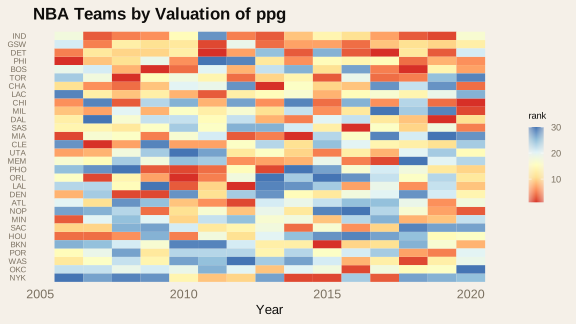
The valuation of points shows that teams should pay for points only when they are in the midst of a dynasty or a major run, and should not make a habit of paying for points — unless teams wish to be middle-of-the-pack teams like the Pistons and Pacers.
Valuing Rebounds
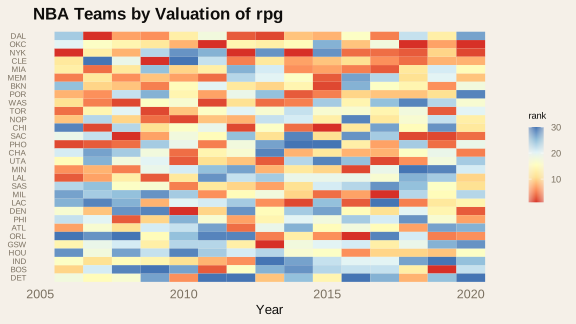
Rebounds show the most glaring difference in team success: good teams devalue the rebound while bad teams overvalue it.
This is proof of a broader, league-wide trend of small-ball and using your salary on points or assists rather than rebounds. Houston, known for their small-ball lineups, find themselves near the bottom of these rankings because they value rebounds so little.
Valuing Three Point Shooting
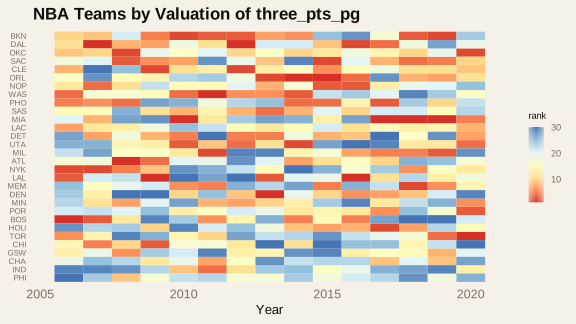
Teams have varied in their three-point shooting valuation, with some recent championship contenders in the Raptors and Heat spending big on three-pointers leading up to their championship runs. The Warriors skew this data a little bit since Steph Curry's contract was so favorable for the team that they appear to undervalue the three-point shot when they simply have a great deal.
Overall…
Team-by-team analysis further illuminates key trends, with high value in assists interestingly the clearest indicator of success. Good teams have devalued rebounds in recent years while bad teams overvalue them. Finally, teams with surprise championship runs in recent years have relied on highly-valuing three-point shots in the years immediately before and during their championship appearances.